Showing posts with label Water. Show all posts

Sunday, July 21, 2013

How New York City Kept Its Drinking Water Pure


. . . and saved billions of dollars
Beginning in the 1830s, the City of New York created a water system generally considered to have no equal in the world. Generations of city leaders chose to go far north and west of the City, to find rural environments that would provide pure, pristine water.

But in the 1980s, as the economics of industrialized agriculture began to undermine the economic vitality of the small family farms that dotted the Catskill mountains, things began to change. Catskill farmers, in a desperate attempt to remain economically viable, began industrializing their own farm operations. Chemical fertilizer use increased, erosion accelerated, and pathogen contamination began to grow. Farmers also began selling off the forested portions of their land for environmentally damaging exurban development.

By the end of the 1980s, public health specialists were publicly stating the City would have to substantially increase the treatment of its drinking water source. The costs for the advanced treatment were estimated to be $4 billion to build and $200 million annually to operate. This would double the cost for water in New York City, with major adverse impacts on low-income families.

Thus, when I became Commissioner of the New York City Department of Environmental Protection and Director of the New York City Water and Sewer system in early 1990, determining if there was any alternative to this was at the top of a very crowded agenda.

However, unlike nearly the entire American water industry and its regulators, both of which were dominated by civil and public health engineers who thought almost exclusively in facility construction terms to solve water quality problems, my background was in management reform, public finance and environmental policy, particularly land use.

My new management team and I were quickly convinced that allowing Catskill drinking water purity to deteriorate and then spending massive sums to clean it up was not the ideal option. The team’s philosophy was that a good environment will produce good water. And that made investing in the environment a smart and profitable investment for New York City.

It took eighteen months of mutual work between the City and the Catskill farming community but, in the end, using concepts that have now come to be called ecosystem services, an innovative and far reaching agreement was crafted.

Operationally, the question became what environmental investments should the city make. Some, such as adding to the publicly held land in the watershed— particularly critical lands threatened by development—along with stream corridor restorations and better stewardship of city owned lands were obvious. But that did not answer how to control non-point source pollution on privately held farmlands and other rural landscapes.

The City began to organize an unprecedented program of regulatory enforcement against non-point source pollution runoffs in its watersheds. Some farmers and other rural landowners reacted angrily. But with the city’s support, the Catskill farmers created a program they called “Whole Farm Planning,” which incorporated environmental planning into the business strategy of the farm. A pollution control plan was developed for each farm by the farmer and local farm and agricultural experts.

To ensure pollution control efforts would reach critical mass, the program set a goal of obtaining the participation rate of 85% of Catskill farmers within five years. Thus, while the program was voluntary for any individual farmer, the Catskill farm community as a whole was committed to reach a goal that would ensure the City met its pollution reduction objectives. After five years, 93% of all Catskill farmers were full program participants.

In terms of Clean Water, the results speak for themselves:
There was a 75% to 80% reduction in farm pollution loading;  
The pristine quality of the City’s drinking water was preserved and improved, and the threat that New York would have to spend billions on advanced treatment of drinking water was eliminated; 
The program paid for itself many times over through its many cost savings and played a critical role in helping to stabilize water and sewer tariffs, providing major benefits to low-income households; 
The program was wildly popular with the public and helped build strong urban support for future watershed protection efforts by New York City.
On a broader scale, the Catskill program spurred watershed protection and environmentally-friendly farm programs throughout the United States and catalyzed interest in non-traditional facility construction approaches of the U.S. water industry.

Ecosystem service payment programs like the one used in New York are a way of capturing the environmental profits from the services rural ecosystems provide urban areas and then funneling those profits back into the rural landscapes and the rural communities that provide them, creating a righteous cycle of mutually supportive economic and ecological investments between urban and rural areas, leading to a more sustainable future for both.

The importance of these payments for environmental services (PES) to the future of rural landscapes in particular cannot be overstated. All over the world, rural landscapes are being transformed at a rate that has no historic or economic parallel. PES payments can stabilize rural land use at a more balanced point by making environmental stewardship a new source of economic wealth for rural populations.

The list of water related ecosystem services is almost endless. Water utilities need to go beyond deployment of their traditional engineering skills and pioneer innovative financial arrangements with upstream residents, as New York City did, to take full advantage of these potentials.

—ALBERT APPLETON
photo from Ephemeral New York (ed: a wonderfully fascinating site)

Editor: Another chapter in Celebrating the Commons: People Stories and Ideas for the New Year from Commons Magazine being presented each Sunday at EYNU.

Sunday, January 27, 2013

A Grassroots Group Stands Up for Everyone’s Water Rights


                            COMMONERS                             


The Detroit People’s Water Board champions the Great Lakes Commons

The Detroit People’s Water Board isn’t waiting for someone else to solve Detroit’s water problems. This community coalition is taking an out- front role on everything from fighting water shutoffs and privatization schemes to helping create a watershed plan for the region.
“Our name is a powerful statement,” says Priscilla Dziubek, a representative on the Board from the East Michigan Environmental Action Council. “People get that we are grassroots and we believe we have a rightful say in what happens with our water.”

The Detroit People’s Water Board (DPWB) is at the forefront of emerging efforts in the Great Lakes region to reclaim the water commons. It was born when community organizers saw the need to bridge a number of different water issues in the city—protecting low-income residents’ access to affordable water, preventing pollution and working to keep Detroit’s water publicly managed and accountable.

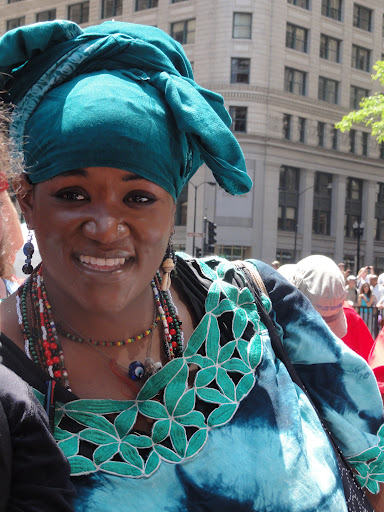
Charity Hicks, one of the founders of this
 grassroots organization to protect 
Detroit’s water for everyone.

“We focus on the question: what does water mean for all of us?” explains Charity Hicks, another founding member, from the Detroit Black Community Food Security Network. “The Board has a cross pollinating effect among people focused on poverty, health, growing food, jobs, ecological survival. We attend to both human and ecological sustainability.”

DPWB seeks to weave together social justice, citizen democracy and ecological health. The foundation for their work is fostering community and a deepened sense of the “we”—encompassing shared responsibility and equitable benefit.

People’s Water Board members could see that people were concerned about their own water, but they weren’t necessarily making a political connection. “Why in a water-blessed region are so many families’ shut off? Why would we turn over something so intrinsic to our public quality of life, our water, to private interests?” questions Hicks, alluding to the Board’s work to reconnect people to their water and to the community’s stake in what is happening. “We need to have a dialogue about those things we hold in common.”

Seeing the water as a commons, as “all of ours,” Hicks and Dzuibek agree, empowers people. They can make a difference in water issues, and in a bigger way in how we will live together and on this earth, Hicks observes. “We are saying: you are part of this conversation, you are an expert, we are all experts. We have full agency. This is what democracy looks like.”

– ALEXA BRADLEY

Editor: Another chapter in Celebrating the Commons: People Stories and Ideas for the New Year from Commons Magazine being presented each Sunday at EYNU.


Saturday, December 8, 2012

Exxon Hates Your Children

How many of you scream at the Exxon Mobile commercials claiming "to care about the children" when we know it is their public relations arm messing with people's heart and mind disconnects to distract and confuse?  Big lies from the big guys - daily, all day.

The following ad has been created to refute the big lie.  *LOLsob*


From Grist:
There are two groups behind this genius ad: Oil Change International — an advocacy organization that’s fighting for clean energy and against fossil fuels — and The Other 98%, which calls itself “a grassroots network of concerned people fed up with the status quo in Washington.” There’s actually a policy agenda behind the ad — eliminating subsidies for fossil fuels. Here’s the argument the two groups are making:
Imagine if your government gave a company a sweet deal to build your local playground. Then, that company dumped toxic waste underneath where your kids play everyday, just because it was the most profitable thing for them to do.

What would you do? Obviously you’d protect your children and demand that the company fully pay to clean up their mess … you’d demand that your government immediately stop sending your tax dollars — subsidies — to that company.

That company is Exxon, the playground is our planet, and the sweet deal they get is by way of massive government handouts.

The groups are raising money for an ad buy next week; “the locations and scope will depend on the online fundraising campaign,” Oil Change International’s director told The Hill. But it looks like one of the audiences they’re looking to reach is Fox News viewers … and I would pay good money just to see how they try and defend Exxon against this argument. “Exxon loves your children! They make it possible for them to drive cars!” “They’re just trying to make money … oh wait …”
Well, this commercial -- brought to you courtesy of Oil Change International and The Other 98% -- answers them. And guess what: ExxonMobil really hates it. Why? Because it tells the stark, horrible truth about how Big Oil and ExxonMobil harms children in real ways, far more than having a bad score on a standardized test. It has them so aggravated that they're pushing to have the ads removed.

Via The Hill: 
“The campaign is offensive to the thousands of ExxonMobil employees and contractors who work hard every day to deliver an essential product in a safe and environmentally responsible way,” the company said in a statement Wednesday.
Via Crooks & Liars:
Well, shoot. I'm sorry, ExxonMobil, but it simply tells the truth about what you're really doing.
The company and oil industry more broadly are battling proposals to end tax deductions, arguing the efforts unfairly single out the industry for punishment and would stymie energy development.

Oil industry critics say that the tax code should not reward fossil fuel development at a time when scientists are increasingly sounding the alarmabout runaway global warming.
In this day of real-time news, it's really impossible for Big Oil to disguise their malfeasance and greed with slick education reform PR campaigns. That's what they really hate.

Wednesday, April 11, 2012

SANDAG - Water & Traffic & Numbers all Questioned

Prior to the meeting tonight, April 11, 2012, with a SANDAG Presentation on the agenda (swoon) it is good to be reminded of the questions from the council three years ago. The companion piece to this was the SANDAG Growth 2050 Forecast posted here in late February. 

What do you feel about the questions and the responses? The responses from the SANDAG demographer seemed like very weasel-like words. Planner Patrick Murphy was candid about the growth numbers coming from the city. It just seems like a real effort must be exerted to get the facts.

Friday, March 23, 2012

Transformational Tree Power

Something to help envision other ways of thinking.  Trees healing the ravages of climate upheavals.  The following has been a real thing in the real world for well over a decade.  Yet one seldom hears an ideas like this in our media, our council chambers.  Changing weather and weathering change are intrinsically tied.


Let's start allowing known facts and experiences in the natural world inform our conversations, our decisions about the present and the future.  All problems of the world solved in the garden, the man says. Beats starting another war for no apparent reason or drilling for oil in the tar sands, national park or the Arctic.

World Water Day was yesterday, making this clip and the updates that followed relevant for now.